Open-source micromouse · ESP32 · simulation first
Ariadne.
A micromouse that designs its own turns, plans in seconds instead of cells, and proves every manoeuvre in a 10 kHz physics model running the exact firmware control law, before a single part is soldered.
2.4×faster fast run than
stop-and-pivot (physics)
stop-and-pivot (physics)
30clothoid turns, each
≥ 12 mm from any wall
≥ 12 mm from any wall
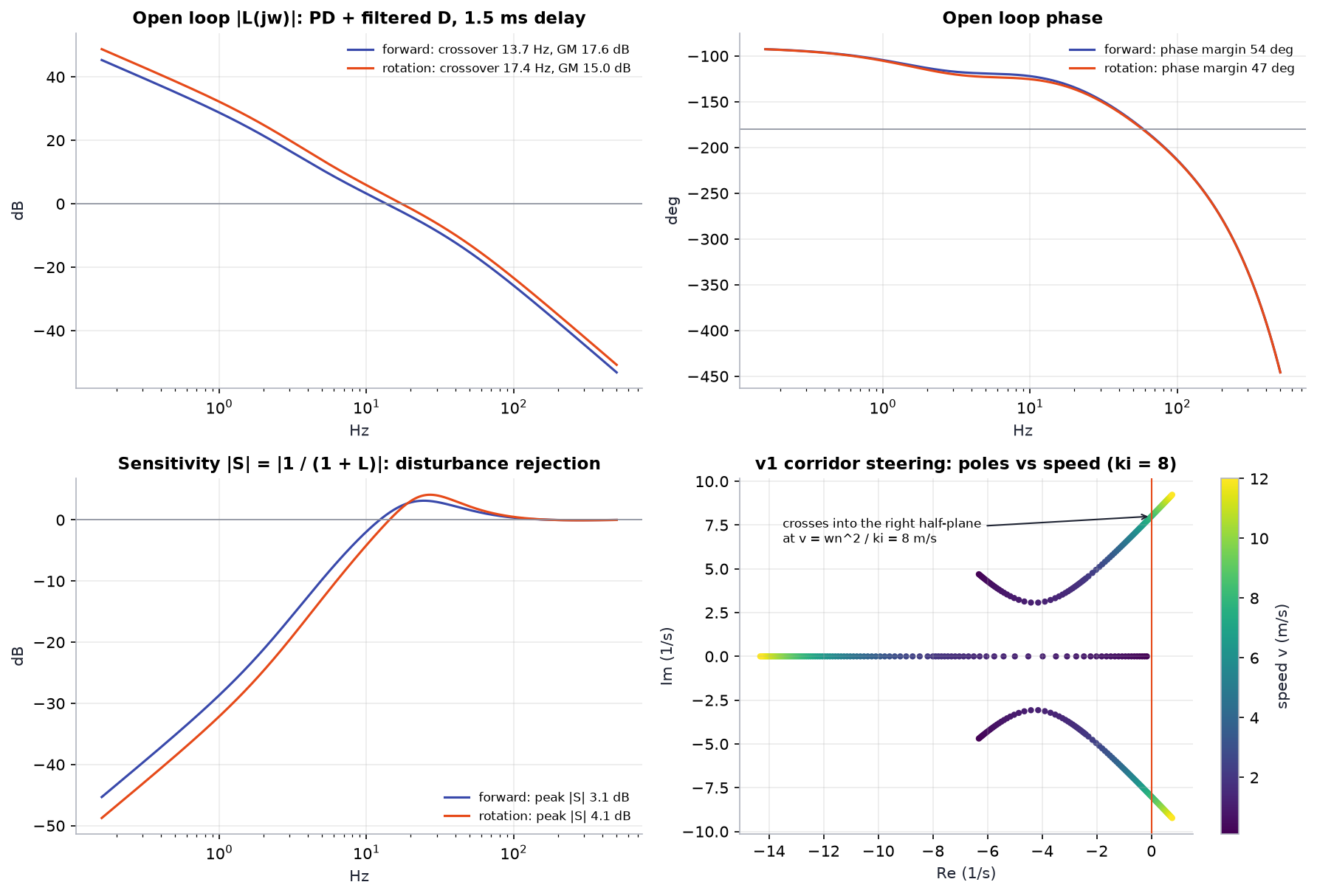
54° / 47°phase margin, forward /
rotation loop at 1 kHz
rotation loop at 1 kHz
32 / 32smooth runs finished,
randomised robots
randomised robots
Same maze. Same physics. Three generations.
Real trajectories from the simulator, played back in real time. Each robot runs the firmware's control law on a model with motor dynamics, tyre friction circles, encoder and PWM quantisation, a noisy gyro and ToF sensors. Colour is speed.
0.00 s
Engineering, not guesswork
Every gain, threshold and turn has a derivation, a test and a number behind it.
Turn synthesis
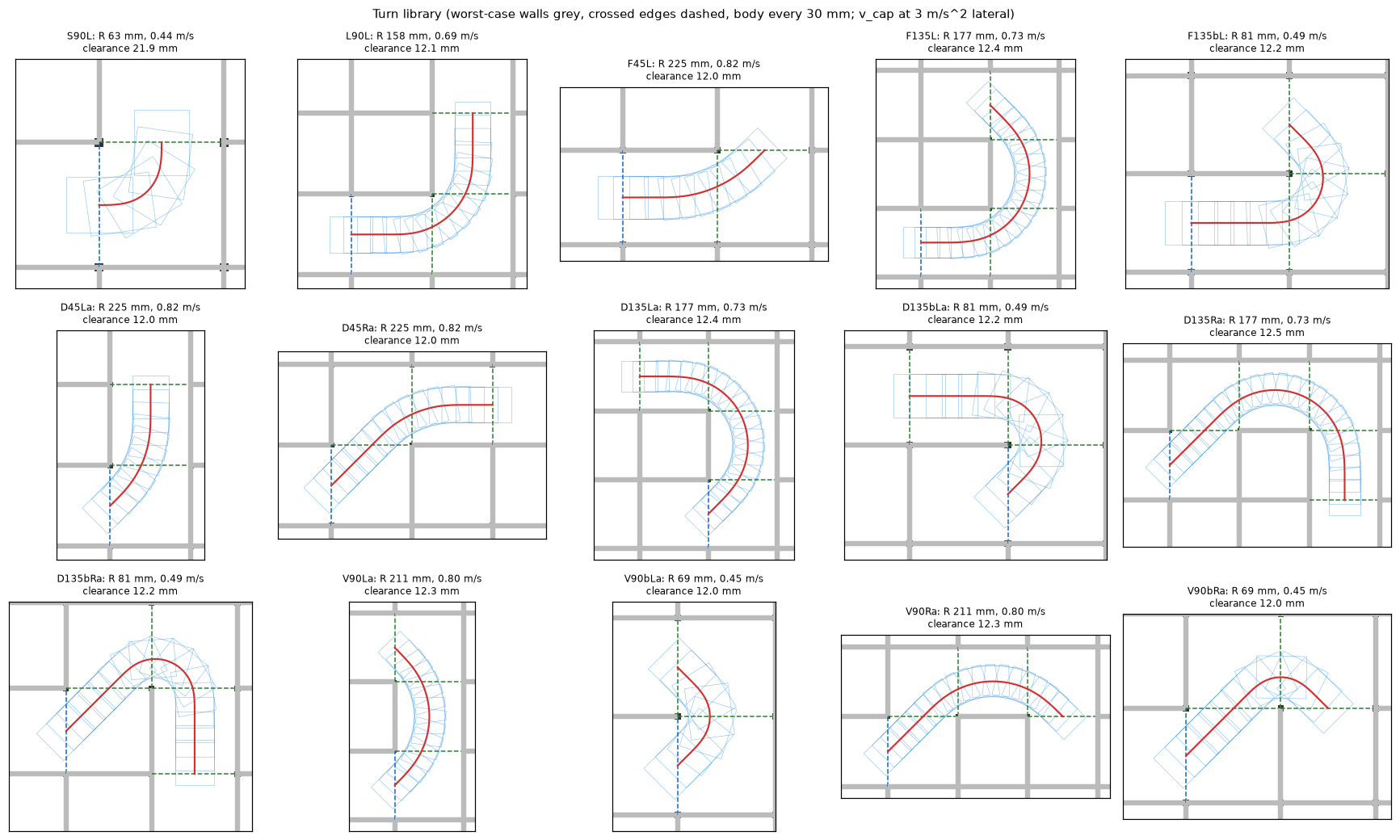
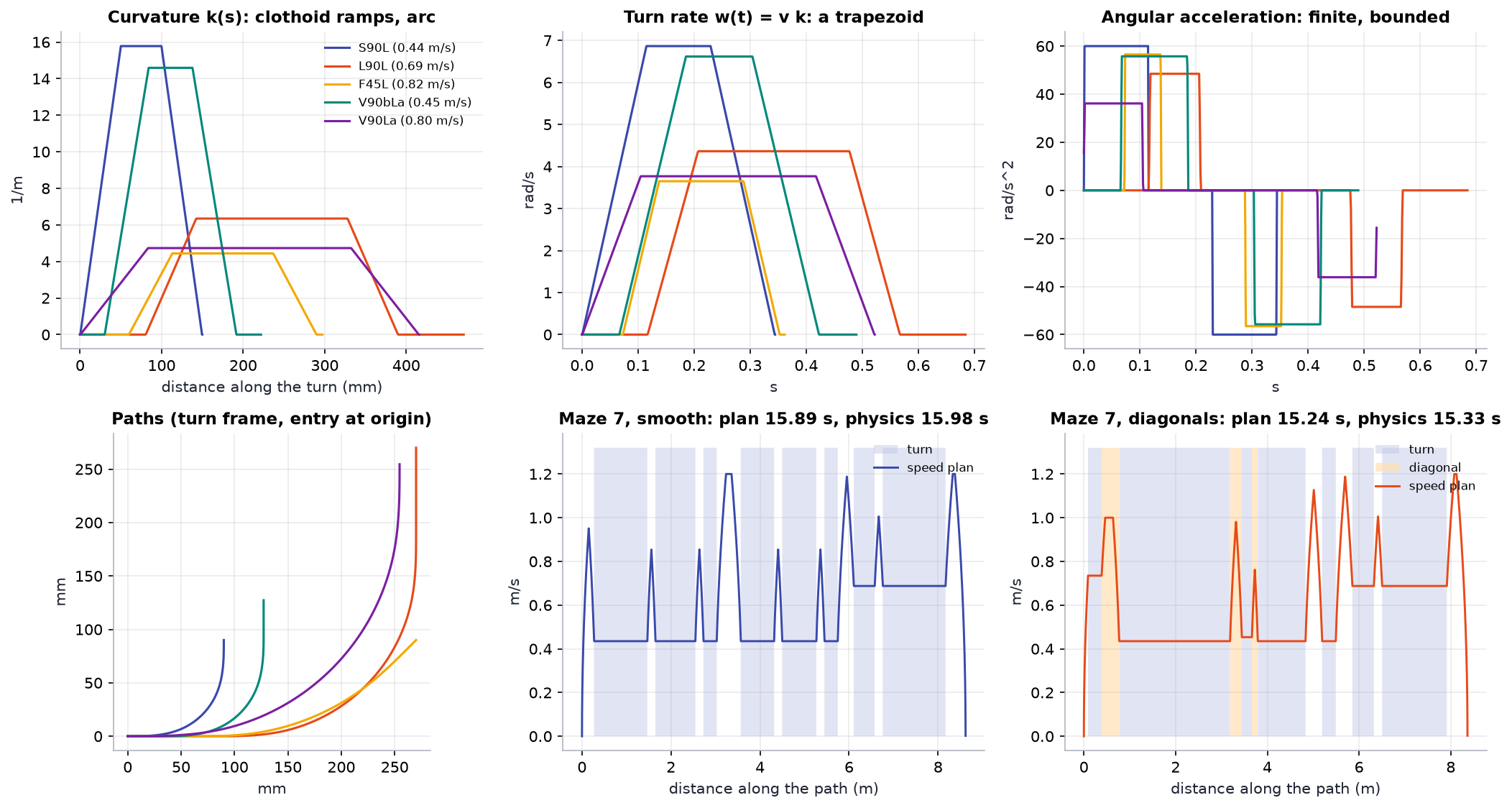
Clothoid–arc–clothoid turns found by search over curvature and ramp shape; the 95×80 mm body is swept against posts and a worst-case wall on every edge it doesn't cross.
Time-optimal planning
Dijkstra over 4,352 edge–heading states with integer costs, then a two-pass speed plan: the fastest profile every boundary constraint allows.
Distance-domain estimation
A triple-pole observer fuses walls into offset, heading and gyro bias per metre travelled, so it is correct at any speed and any sensor rate.
Model-based control
Pole placement on the DC-motor model, feedforward from the inverted plant, filtered derivative and gain-scheduled lateral control, all with stability margins checked.
Physics in the loop
Monte Carlo over manufacturing tolerances, friction, battery and sensor errors, with 95 % Wilson intervals on every reliability number.
Firmware that matches
FreeRTOS on two cores. The C++ planner reproduces the Python one bit for bit, verified on the PC by unit tests against simulator-exported vectors.
From maze to motor voltage
- Searchflood fill, stops when the path is provably optimal
- PlanDijkstra on edges × 8 headings, 30-turn library
- Speed planforward / backward pass, exact time
- Run1 kHz plan runner, closed-form heading reference
- Trackpath following on the pose estimate
- Observewalls → offset, heading, gyro bias, along-track
Where it stands
The simulator, planners, estimator and firmware are complete and tested. The firmware builds for the ESP32 with zero warnings. It has not driven a real maze yet: the next step is hardware, and that is where sponsorship comes in.
Read the roadmap- v1 flood fill, pivot planner, physics model, ESP32 firmware
- v2 clothoid turns, diagonals, path following, wall observer
- v3 design studies, website, custom-PCB proposal
- Next build and validate on a real maze, publish flight logs
- Then custom PCB: IR sensors at 1 kHz, better IMU, compact low-inertia chassis
Help put Ariadne on real wheels
The studies say exactly what the next hardware buys: a compact PCB chassis raises the angular acceleration that caps every turn, 1 kHz IR sensors cut path error, a better IMU makes diagonals viable. Your support pays for the boards, parts and test maze, and everything that comes out of it stays open.